Range Repair
Wolf Burner Clicks but Will Not Light: Working Through It
Clicking proves the spark half of the system works, so what is missing is on the gas side. Find out whether one burner or all of them are affected, check cap seating, ports and the electrode, then the supply. A gas smell that lingers means leave and call the utility.
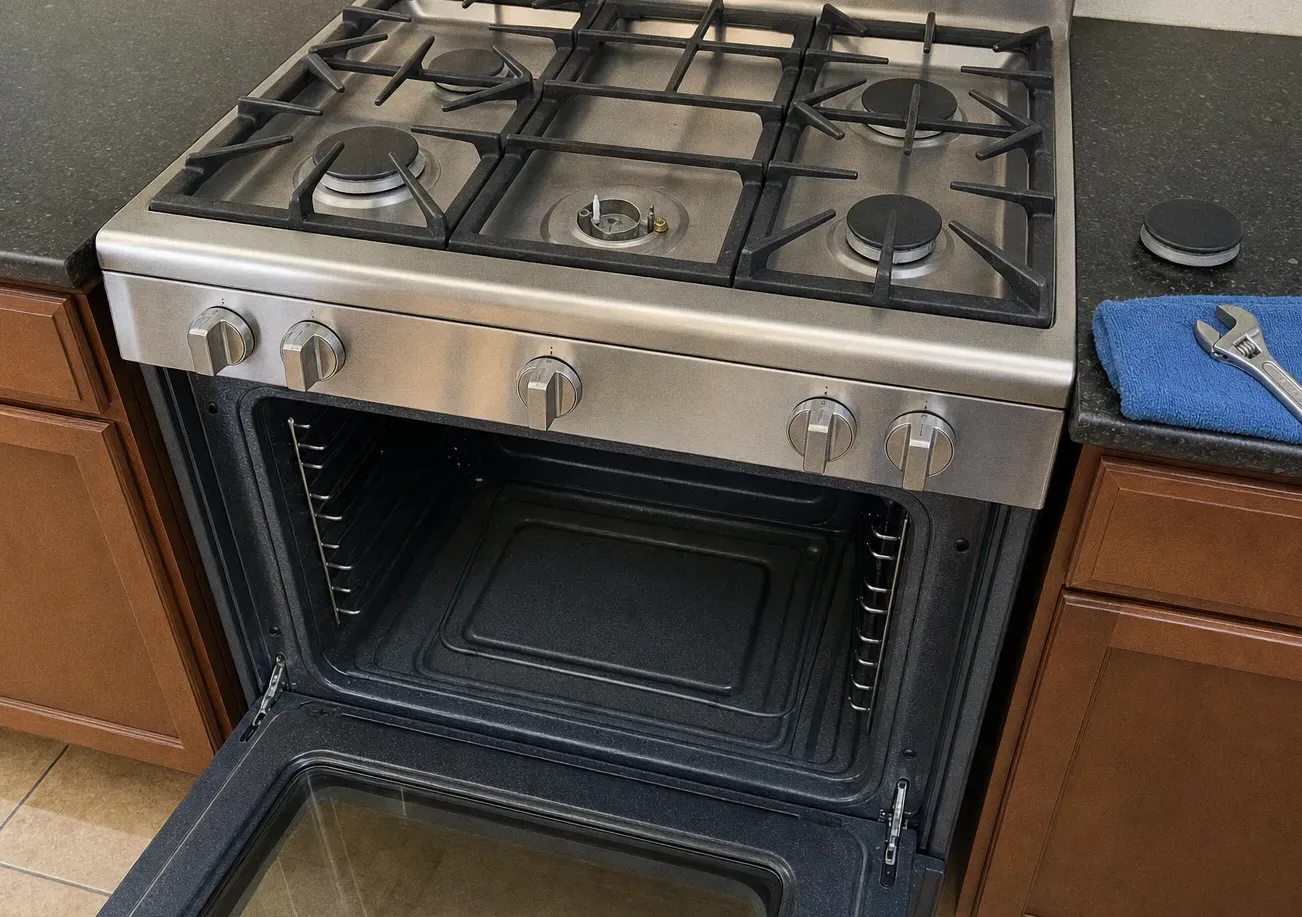
One safety point ahead of everything else. A gas odour that lingers means you leave the building, avoid switching anything on or off as you go, and telephone the gas utility from the street. A repair firm is the wrong first call in that situation, and we would only tell you the same thing.
Now the ordinary version. The knob turns, the tick-tick-tick starts, and nothing catches. Frustrating as that is, the clicking is genuinely good news, because it tells you one half of this appliance is alive and working. Lighting a burner takes two independent things happening in the same place at the same moment: a spark, and gas. You can hear the first one. The whole diagnosis is finding out which of the two is missing.
Start by finding out how much of the range is affected
Establish the spread of the fault before you investigate any of it. A single burner narrows everything to that head — its cap, its ports, its electrode. Every burner failing at once moves the question to the shared module, the earth connection, or the gas coming into the appliance. And clicking with all knobs in the off position is its own separate fault, living in the switches behind the knobs.
Note what you observe before you start dismantling: which positions on the range fail, whether the failure is consistent or occasional, whether anything on the appliance was cleaned or moved shortly beforehand.
Brookline puts its own pressure on this. Coolidge Corner kitchens sit inside apartment buildings where service arrives through a shared lobby and a small lift, and the range will not simply be rolled forward for a look behind it. The same is true of the Longwood rowhouses, where the kitchen is upstairs off a narrow service stair. Anything you can determine from the front of the appliance saves real time, and in Fisher Hill and Putterham houses where access is easier, it still saves a wasted afternoon.
The cap, the ports and the last time it was cleaned
Take the cap off the failing burner and inspect how it registers onto the head. These caps drop into one orientation. Sitting a fraction high, or a few degrees out of position, changes the path the flame is meant to take and can prevent lighting entirely no matter how good the spark is. Replace it, let it settle, and press one side with a fingertip — movement means it is not home.
Blocked ports come next. Carbon and dried spillage close up the small openings around the head, and clearing them wants a soft brush plus, at most, the straightened tip of a paperclip. Anything that removes metal is off limits, because enlarging a port permanently alters how that burner behaves.
Then there is the pattern we see constantly in Coolidge Corner after a dinner party: the range was scrubbed the night before and will not light the morning after. Water trapped in the head or bridging the electrode suppresses ignition until it has dried out completely. Pull the caps and heads, leave them somewhere with air moving over them, and go by whether they are actually dry rather than by any particular number of hours.
The electrode: position, cleanliness and cracks
Turn the kitchen lights down and watch what the spark does. Look for a tight snap that lands in the same spot on every discharge, jumping from the electrode tip to whatever metal of the burner head sits nearest. A spark that strays, splits, or lands on a grate finger is being spent before it reaches any gas at all, and the module will happily go on clicking about it.
The usual culprit is a fine crack in the white ceramic sleeve. Once that has opened, the discharge tracks down the sleeve to the nearest earthed metal rather than jumping the gap it was designed for. What you see is a burner that clicks strongly, catches occasionally, and deteriorates whenever the surface is wet.
Baked-on residue does something similar by giving the spark a conductive path across the ceramic. That much you can clean. A cracked sleeve is a replacement.
Keep hold of the principle here. Clicking is the sound of the module firing. It carries no information whatsoever about whether the spark arrived somewhere useful, and a lot of wasted effort starts with assuming it does.
The supply side of the question
If the spark looks right and the burner still refuses, the question flips to the gas half. Test it without tools. Does the oven light. Does any other gas appliance in the building work. Has there been an interruption to the supply, or work on the meter, in the last few days. Two failures in one building is a building problem, not a range problem.
Check that the appliance shut-off is fully open. In apartment kitchens it is often behind a panel or a drawer stack and gets nudged during other work.
Beyond that, stop. Orifices, the regulator, the flexible connector and the valve body behind each knob are all past the line where a homeowner should be experimenting, and none of them can be assessed by eye or by smell.
Where to stop
Two behaviours end the do-it-yourself stage on the spot. The first is delayed ignition — a burner that hesitates and then lights with a thump, having let gas gather first. That is more urgent than a burner that never lights, and it should not be used again until it has been looked at. The second is a burner that comes alight and then goes out by itself, or one that keeps sparking after it is burning. On models with flame supervision, both mean the appliance can no longer confirm it is lit.
What a visit adds is measurement rather than opinion: spark behaviour with gas present, whether the valve is genuinely opening when the knob turns, and what the appliance is being supplied. The service call is $95. Igniter or spark module replacement runs $270 to $690, and burner valve or orifice service $260 to $1,090, depending on which half of the problem it turns out to be.
We work throughout Brookline, including Fisher Hill, Longwood and Putterham. The telephone number and the scheduling link above are the two routes in.
Still asked on the phone
Can I clean the ports with a pin or a paperclip?
A straightened paperclip or a wooden toothpick, used gently, alongside a soft brush, is acceptable. What is not acceptable is anything that removes metal: a drill bit, a needle file, a sewing needle forced through. Widen an opening even slightly and it will meter gas differently for the rest of the appliance's life.
I can smell gas. What should I do?
Leave the building straight away. Do not operate switches, do not use a telephone indoors, and do not go looking for the source. Once you are outside and well clear, ring the gas utility's emergency number, because leaks are their work. Only once the supply has been made safe does an appliance repair become relevant.
It started right after I cleaned the range. Why?
Two reasons, and both are common. Caps and heads frequently go back a fraction out of register, which alters the flame path enough to stop a burner catching. And water sitting in the head or bridging the electrode will suppress the spark until it has dried out. Lift it all off, dry it properly, refit it squarely.